
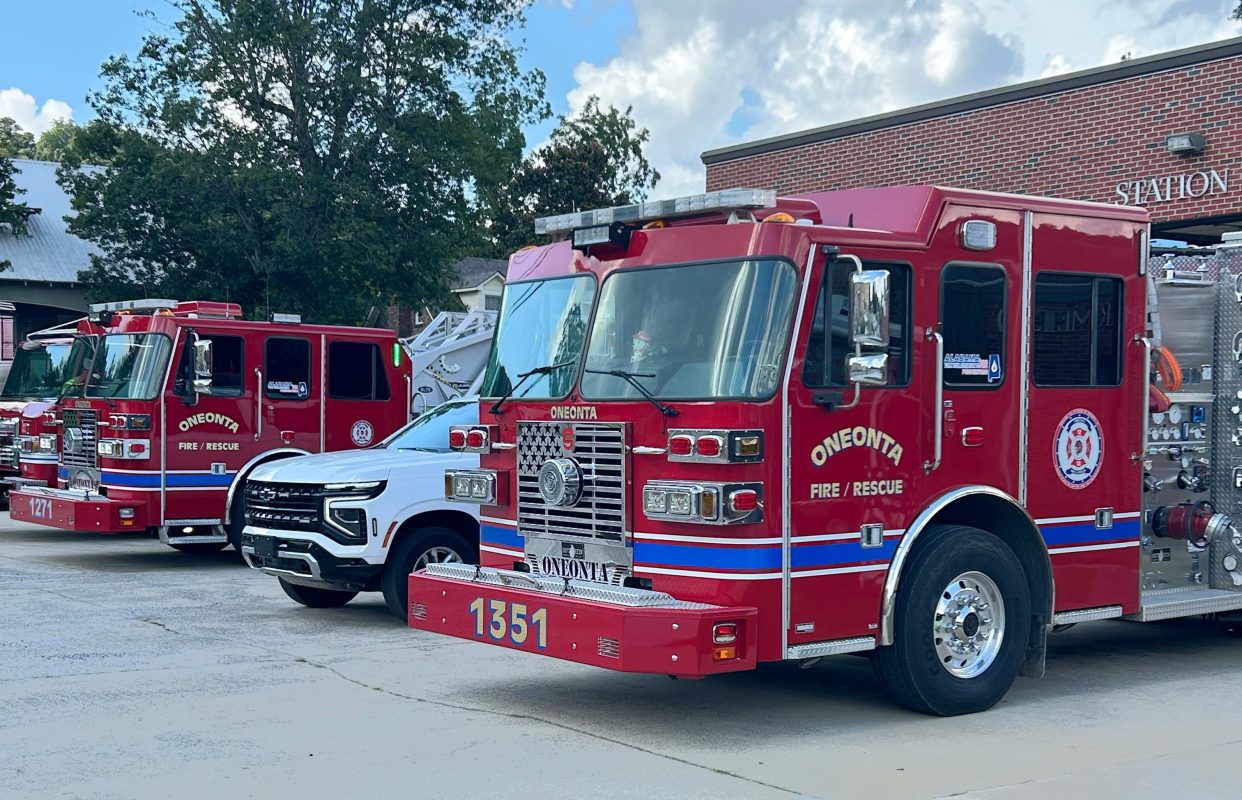
The City of Oneonta, Alabama is now equipped with the EMTRAC Emergency Vehicle Preemption (EVP) system. The EMTRAC EVP system installed along critical city corridors utilizes 900 MHz radio to enable first-response vehicles to request green signals while approaching intersections, resulting in reduced response times and improved safety while enroute.
The EMTRAC system became active in May 2026, and it was installed through a partnership including Oneonta Fire and Rescue Services (OFRS), Alabama Department of Transportation, STC, Inc. (EMTRAC manufacturer), and Priority Systems Specialists (EMTRAC sales).
Throughout the testing and system-launch phases, Oneonta Fire and Rescue measured response times, traffic-control operation, and overall system performance—and modified system settings when appropriate. The EMTRAC system provided detailed response data, which enabled OFRS to precisely evaluate improvements along routes served by the agency.
After measuring and analyzing the data, Oneonta Fire Chief Tyler Seehusen reported “We are lowering response times to between 30 seconds and 1 minute 30 seconds, depending on the route.”
How significant is a reduction in fire-department response of between 30 seconds and 1.5 minutes?
One of the most extensive studies on the costs associated with response times was conducted in 2005 by the Boston Globe[1]. The study connected response times with both fire fatalities and property losses, based on data from the US Fire Administration’s National Fire Incident Reporting System (NFIRS), the nation’s largest fire-incident database[2].
One of the most striking findings of the study found that the cost of each additional minute rose sharply as the fire progressed. Between three and seven minutes, average property losses increased by roughly $6,000 per minute when adjusted for 2026 inflation. However, between seven and nine minutes, losses increased by more than $17,000 per minute[1].
The primary conclusion of the Boston Globe study was that every minute matters. Even small increases in response times showed measurable increases in average property loss, as well as fatalities. Delays beyond eight minutes resulted in substantially worse outcomes—in costs associated with property loss (as shown below) as well as injuries and fatalities.
The 2005 Boston Globe report included averages for increasing property-damage costs at four response-time benchmarks (3, 5, 7, and 9 minutes).
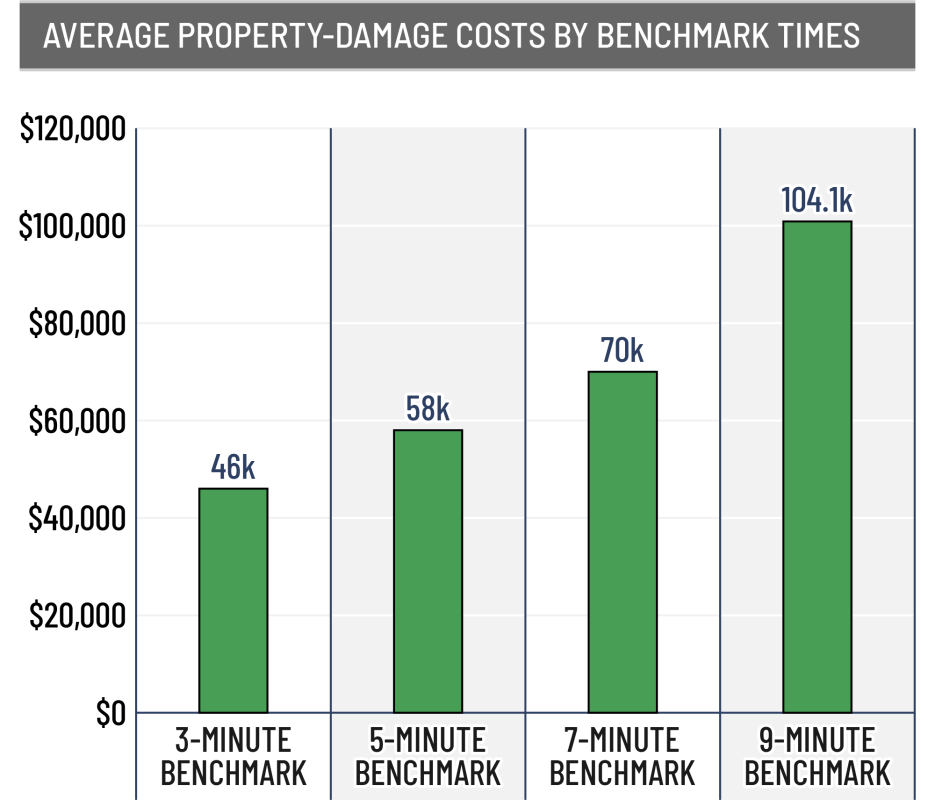
| FIRE DEPARTMENT RESPONSE TIME AND AVERAGE PROPERTY LOSS[1] | ||
| Response Time | Property Loss (2005 dollars) | 2026 Equivalent |
| 3 minutes | $27,000 | $46,055 |
| 5 minutes | $34,000 | $57,999 |
| 7 minutes | $41,000 | $69,943 |
| 9 minutes | $61,000 | $104,064 |
When Oneonta’s response-time reductions are applied to the benchmark times in the Boston Globe study, the data reveals an average total response-time decrease of 16.7 percent.
| ONEONTA FIRE-INCIDENT PERFORMANCE BY THE MINUTE[1] | ||
| Benchmark | Savings (by the second) | Percentage Saved |
| 3 minutes | 30 seconds | 16.7% |
| 5 minutes | 50 seconds | 16.7% |
| 7 minutes | 70 seconds | 16.7% |
| 9 minutes | 90 seconds | 16.7% |
The National Fire Protection Association (NFPA) publishes a comprehensive list of response-time standards for both career and volunteer fire departments every three to five years (NFPA Standard 1710 for career fire departments). For fire-suppression incidents, NFPA 1710 sets a benchmark of eight minutes or less for the full complement of firefighters to be on scene, for at least 90-percent of incidents.
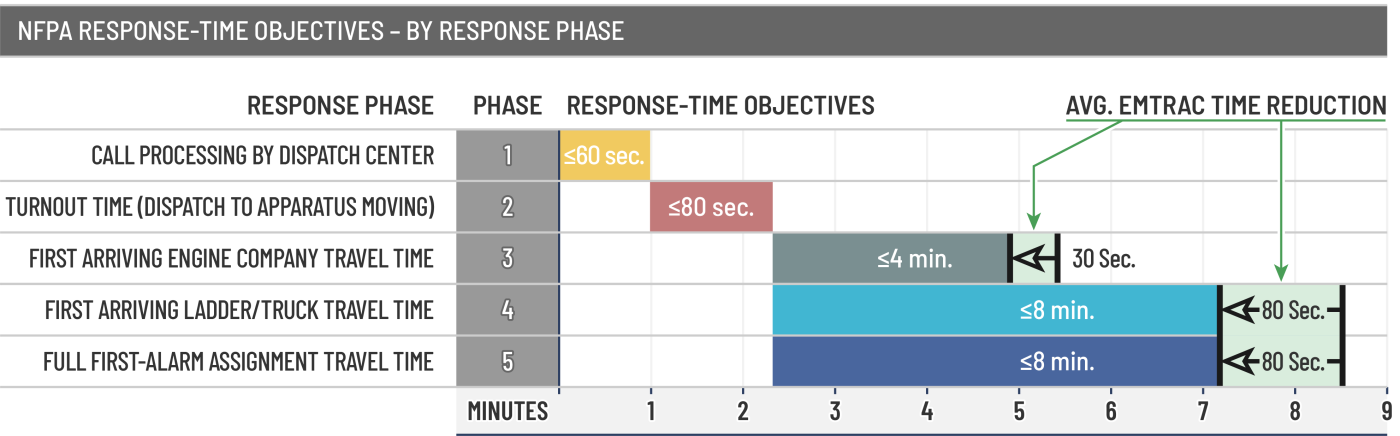
| NFPA RESPONSE-TIME OBJECTIVES | ||
| RESPONSE PHASE | RESPONSE-TIME OBJECTIVES | AVG. EMTRAC REDUCTION |
| Call processing by dispatch center | 60 sec. or less | N/A |
| Turnout time (from dispatch to apparatus moving) | 80 sec. or less | N/A |
| First arriving engine company travel time | 240 sec. (4 minutes) or less | 30 seconds |
| First arriving ladder/truck company travel time | 480 sec. (8 minutes) or less | 80 seconds |
| Full first-alarm assignment travel time | 480 sec. (8 minutes) or less | 80 seconds |
The National Fire Protection Association (NFPA) sets 80 seconds as the benchmark for turnout time (that is, when the first engine leaves the station). When measuring only travel times against Oneonta’s response-time reductions, the percentage of saved time is even greater when utilizing the EMTRAC system, as shown below.
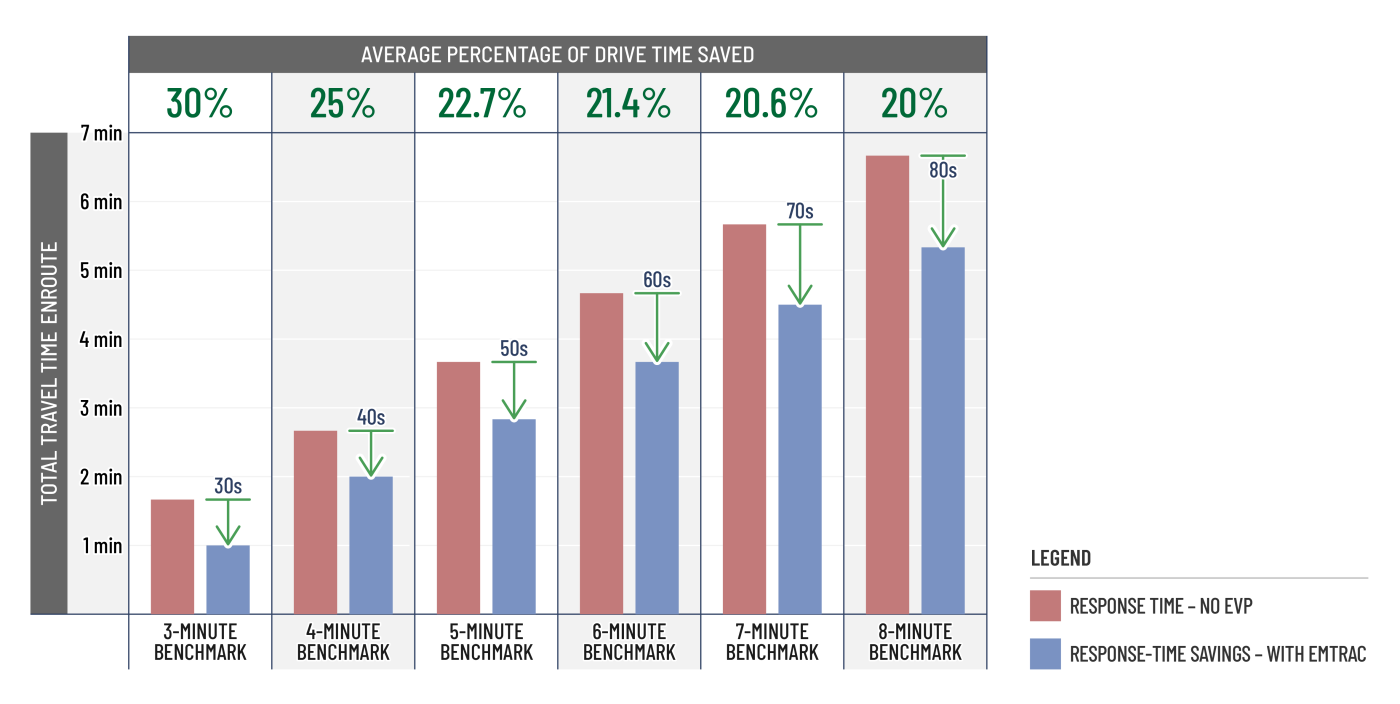
| AVERAGE TRAVEL-TIME REDUCTIONS BY THE MINUTE | |||
| Benchmark | Travel Time | Time Savings | Percentage Saved |
| 3 minute | 1 min, 40 sec | 30 seconds | 30.0% |
| 4 minute | 2 min, 40 sec | 40 seconds | 25.0% |
| 5 minute | 3 min, 40 sec | 50 seconds | 22.7% |
| 6 minute | 4 min, 40 sec | 60 seconds | 21.4% |
| 7 minute | 5 min, 40 sec | 70 seconds | 20.6% |
| 8 minute | 6 min, 40 sec | 80 seconds | 20.0% |
| 9 minute | 7 min, 40 sec | 90 seconds | 19.6% |
How do lower response times decrease property-damage costs from fire incidents?
Data from many millions of fire incidents show that each additional minute increases costs resulting from property damage, and that these costs take a significant upswing after eight to ten minutes. Fire-growth studies generally find that a structure fire can approximately double in size every minute during early growth stages, making each minute increasingly costly.
Property-insurance rates for a given community are generally lower in areas with greater fire department staffing, equipment, training, and deployment. Both residential and commercial-property owners experience reduced insurance premiums as a result of fire departments meeting standards such as NFPA 1710.
The following table provides an estimate of average yearly residential and commercial property-loss savings per fire department, based on the data from the 2005 Boston Globe study.
| AVERAGE PROPERTY-LOSS SAVINGS WITH EMTRAC | ||||
| Response Time | Average Loss* | Cost per Sec. | EMTRAC Savings | Avg Yearly Savings per Fire Department |
| 3 minutes | $27,000 | 30 seconds | 30 sec. | $10,654,056,667 |
| 5 minutes | $34,000 | 50 seconds | 50 sec. | $13,417,102,000 |
| 7 minutes | $41,000 | 70 seconds | 70 sec. | $16,180,147,333 |
| 9 minutes | $61,000 | 90 seconds | 90 sec. | $24,073,472,000 |
*The data in this table is based on the averages derived from the US Fire Administration’s National Fire Incident Reporting System (NFIRS)[2], adjusted for 2026 inflation. Individual property losses vary depending on occupancy type, fire load, suppression systems, time of day, weather, and whether the fire has reached flashover.
How do fire-department response times affect fatalities?
While the Boston Globe study did not publish a table showing the fatality risk by each minute of increased response time, it did report two key findings regarding fatality risks:
- Each additional minute of fire department response time increased the probability of a fire fatality by approximately 0.5 percent.
- Fires with responses greater than eight minutes had approximately a 4.1-percent higher probability of a fatality than fires with faster responses.
How has Chief Seehusen and his crews reacted to installation of the EMTRAC system in their community?
When asked about his reaction to the newly installed EMTRAC system, Chief Seehusen remarked “The technology has allowed us to improve response times, ease movement through a very congested area, and make our responses safer. After some final adjustments, the system seems to work flawlessly on every emergency response.”
When asked how his fire crews and others have reacted to the newly installed technology, Chief Seehusen added “The crews and police officers are extremely impressed with this system. We hope to expand it to the Oneonta Police Department in the future.”
The EMTRAC system is utilized by fire departments and first-response agencies throughout North America. Review the articles and videos below to learn more about how Oneonta Fire and Rescue Service is using the EMTRAC system to decrease response times in their city.
Please contact us to learn how the EMTRAC system can save money and, most importantly, lives in your community.
References
- Boston Globe Media owns The Boston Globe newspaper, which is one of the oldest and most-respected daily newspapers in the US. In 2005, The newspaper produced a landmark investigative series titled “Deadly Delays: The Decline in Fire Response” led by reporter Bill Dedman. The report analyzed data relating to approximately 3.3 million building fires as reported by approximately 20,000 US fire departments between 1986 and 2002. The Boston Globe investigation revealed a clear statistical relationship between longer response times and higher average property damage.
- The US Fire Administration (USFA) mission is to reduce the impact of fire and other emergencies through data collection, training, public education, and support of the nation’s many fire services. The National Fire Incident Reporting System (NFIRS), which was replaced by the National Emergency Response Information System (NERIS) in 2026, has been the foundation of US fire-service data collection for decades. NFIRS was also the primary source for the 2005 Boston Globe study cited in this report.
- The National Fire Protection Association (NFPA) maintains a detailed list of recommended requirements, which include installation standards, test-methods, fire codes, organizational standards, and others. Fire departments that meet NFPA standards benefit through increased fire-fighter safety, reduced fire loss and casualties, improved insurance ratings (for both the agency as well as community homeowners and businesses), and increased opportunities for both accreditation and grants.
- The Center for Public Safety Excellence (CPSE), and its Commission on Fire Accreditation International (CFAI), is the premier national fire department accreditation and first-response credentialing body in the United States. There are fewer than 350 agencies nationwide that have achieved CFAI accreditation. The CPSE considers response times an important measure of fire-department performance because they directly influence emergency outcomes—in terms of lives saved, injuries prevented, and property protected. The CPSE also considers the results crews achieve once on scene as the most important measure of success.
Learn more about Oneonta’s EMTRAC implementation
- Oneonta Fire and Rescue Begans Use of Emergency Traffic Signal Preemption System
Article – WBMA (ABC) – Birmingham, AL - New Tech for Oneonta Fire
Video – WBRC (Fox) – Birmingham, AL - Oneonta Fire and Rescue Begans Use of Emergency Traffic Signal Preemption System
Article – Daily Dispatch (Western Fire Chiefs Association) - Our emergency vehicles now utilize the EMTRAC Emergency Vehicle Preemption system
Facebook – Oneonta Fire and Rescue Services - YouTube – EMTRAC